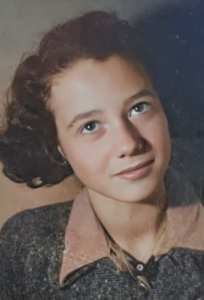
Educational purpose only. This text documents historical events related to World War II and firmly condemns the Nazi regime, its war crimes, the Holocaust, racism, antisemitism, and all forms of totalitarian ideology. It does not glorify violence, hatred, or persecution. The account is based on verified historical sources, survivor testimony, and scholarly research.
Dita Kraus: The Holocaust Survivor Who Became “The Librarian of Auschwitz”
Dita Kraus (born Edith Polachová on 2 July 1929 in Prague) is one of the last living witnesses to the inner life of Auschwitz-Birkenau’s family camp. Her story illustrates not only the machinery of Nazi genocide but also the quiet, determined acts of cultural and spiritual resistance that prisoners maintained even in the shadow of the gas chambers.
Raised in a secular Jewish family in interwar Czechoslovakia, Dita enjoyed a stable, middle-class childhood until the German occupation of Bohemia and Moravia in March 1939. Successive anti-Jewish decrees progressively stripped her family of rights, livelihood, and security. Her father, a lawyer, lost his position; the family was forced into overcrowded Jewish housing; and Dita, like all Jewish children, was banned from public schools. Underground classes organised by Jewish teachers became her first experience of clandestine education.
Theresienstadt: Propaganda and Precarious Normalcy
In December 1942, Dita and her family were deported to the Theresienstadt (Terezín) ghetto. Established by the Nazis as a “model Jewish settlement” for propaganda purposes, Terezín was presented to the outside world — most notoriously during the June 1944 Red Cross visit — as a humane place of resettlement. In reality, it served as a transit camp and site of mass suffering. Overcrowding, malnutrition, and disease were rampant, and thousands were later sent to their deaths in the East.
Despite these conditions, Jewish educators and youth leaders worked to preserve intellectual and cultural life for the children. Figures such as Fredy Hirsch, a charismatic German-Jewish sports instructor and youth leader, organised games, performances, and secret lessons. These efforts constituted a form of spiritual resistance: an insistence on maintaining human dignity and transmitting knowledge when the Nazi project aimed at total dehumanisation and erasure of Jewish culture.
Auschwitz-Birkenau: The Family Camp and the Secret Library
On 15 December 1943, Dita, then aged fourteen, arrived at Auschwitz-Birkenau with her parents after a brutal transport in sealed cattle wagons. They were assigned to the so-called Theresienstadt family camp (BIIb), a unique section of Birkenau where, for propaganda reasons, men, women, and children were temporarily kept together. Conditions remained lethal: chronic hunger, disease, forced labour, and arbitrary violence.
Within this environment, Block 31 — the children’s block under Fredy Hirsch’s supervision — became a fragile island of normalcy. Children sat on small stools for secret lessons in history, literature, mathematics, and languages. A handful of books had been smuggled into the camp. Dita Kraus was entrusted with guarding and distributing these precious volumes. She became, in effect, the block’s librarian. The risk was immense: discovery of forbidden educational materials could result in immediate execution for both the children and the adults involved.
Historical commentary: The existence of Block 31 and Dita’s role as librarian exemplify what historians such as Yehuda Bauer and Saul Friedländer have described as “spiritual resistance” or “resistance through culture.” In a system designed to destroy not only bodies but Jewish identity and memory itself, the act of teaching children and preserving books was profoundly subversive. It asserted that even under genocidal conditions, the transmission of knowledge and human values could continue. Dita’s story thus challenges any simplistic narrative of total victimhood; it reveals the agency and moral courage of individuals who refused to surrender their humanity.
On 8–9 March 1944, the Nazis liquidated the first group of prisoners from the family camp — those who had arrived in September 1943 — after the six-month period they had cynically promised as “protection.” Approximately 3,800 people, including most of the children from Block 31, were gassed. Fredy Hirsch, who had reportedly planned some form of collective resistance or protest, died by suicide or was killed on the eve of the liquidation. Dita survived this massacre only because her transport had arrived three months later; her group was not yet subject to the same deadline.
Selections, Transfers, and the Final Months
In subsequent selections conducted by SS physician Josef Mengele, Dita was chosen for labour deportation. She told Mengele she was sixteen and a portrait painter; he accepted the claim and spared her. From Auschwitz she was sent to subcamps of Neuengamme near Hamburg, where prisoners cleared rubble under Allied bombing raids amid starvation and exhaustion. In early 1945 she and her mother were transferred to Bergen-Belsen, by then a site of catastrophic overcrowding, typhus, and mass death.
Historical commentary: Mengele’s selections were not random; they formed part of the Nazis’ utilitarian calculation of who could still be exploited for labour before extermination. Dita’s quick thinking in claiming an older age and a useful skill was a common survival tactic among prisoners, yet it also underscores the grotesque arbitrariness of life and death decisions made by a single individual operating within a genocidal bureaucracy. The transfer to Neuengamme and Bergen-Belsen reflects the final chaotic phase of the camp system, as the Nazis attempted to evacuate prisoners westward while the Reich collapsed.
Liberation and the Long Road of Survival
British forces liberated Bergen-Belsen on 15 April 1945. Dita’s mother died of typhus only days later. At fifteen years old, Dita returned alone to a devastated Prague. Like many survivors, she faced not only physical recovery but profound psychological trauma and, in post-war Czechoslovakia, a complex social and political environment that was not always welcoming to returning Jews.
She later married Ota B. Kraus, another Auschwitz survivor and writer. They raised three children and eventually settled in Israel, where Dita worked as a teacher. In her later years she became an author, most notably through her memoir The Librarian of Auschwitz (first published in Czech, with a widely read English edition in 2015). Her testimony has contributed significantly to Holocaust education worldwide.
As of 2026, Dita Kraus remains alive at the age of 97 — living proof of resilience, but also a reminder of how few child survivors of Auschwitz reached old age.
Broader historical reflections
Dita Kraus’s experience illuminates several key themes in Holocaust historiography. First, it demonstrates the Nazis’ sophisticated use of deception: Theresienstadt and the family camp were instruments of propaganda designed to mask the reality of genocide from both the victims and the outside world. Second, it highlights the gendered and generational dimensions of survival and resistance; women and young people often played crucial roles in preserving culture and morale under extreme conditions. Third, her post-war life underscores the long-term consequences of trauma and the moral imperative of testimony. Survivors like Dita did not merely endure; many consciously chose to educate future generations, transforming personal survival into a collective act of memory and warning.
Her story also serves as a powerful counter-narrative to denial and distortion. In an age when Holocaust memory faces new challenges from revisionism and forgetting, individual testimonies such as Dita’s remain essential primary sources. They humanise the statistics — the approximately 1.1 million people murdered at Auschwitz-Birkenau — and remind us that behind every number was a person who loved, learned, resisted in small ways, and struggled to remain human.
The courage of Dita Kraus and the educators of Block 31 was not the armed uprising of the Warsaw Ghetto or the Sonderkommando revolt of October 1944, but it was resistance nonetheless. It was the refusal to let the Nazi regime achieve its ultimate goal: the complete annihilation not only of Jewish bodies but of Jewish memory, culture, and future. In preserving books and teaching children under the watchtowers of Auschwitz, Dita Kraus helped ensure that memory itself became a form of defiance.
Primary and scholarly sources
- Dita Kraus, The Librarian of Auschwitz (memoir and related interviews)
- Yad Vashem Archives – survivor records and testimonies
- Auschwitz-Birkenau State Museum archives and historical research
- Scholarly works on the family camp and spiritual resistance (including studies by Yehuda Bauer, Saul Friedländer, and others)
- Verified biographical materials from Holocaust research institutions
This rewritten account corrects minor chronological and contextual simplifications in the original while expanding the historical analysis to reflect established scholarship on the Holocaust, daily life in the camps, and the nature of resistance under genocidal conditions.
