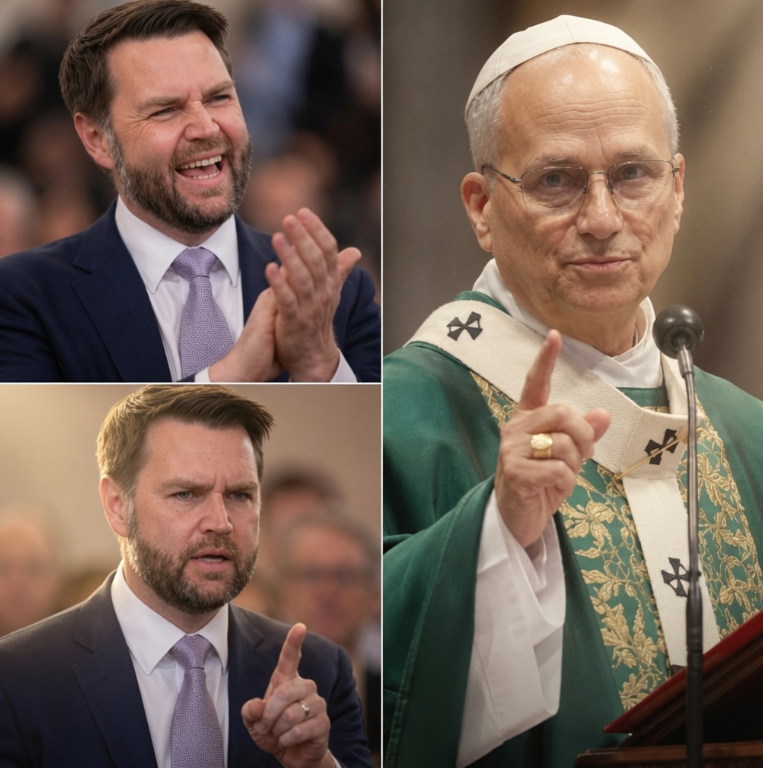
VATICAN CITY — A renewed debate over faith, politics, and public responsibility has drawn attention beyond the United States, including among Canadian readers who are closely watching how public leaders speak about compassion, inclusion, and care for vulnerable communities.
The discussion began after remarks attributed to U.S. Vice President J.D. Vance and a response linked to Pope Leo XIV circulated widely online, prompting a broader conversation about whether empathy in public life should be seen as a moral strength or dismissed as political weakness.
According to accounts shared across social media, the exchange followed criticism of the Pope’s public message on inclusion, human dignity, and concern for people facing hardship. While the details of the exchange continued to be discussed and interpreted in different ways, the central issue quickly became larger than one political figure or one religious leader.
At the heart of the debate was a question that feels especially relevant in many democratic societies, including Canada: how should leaders speak about people who are poor, displaced, isolated, or struggling to be heard?
Pope Leo XIV’s reported response framed compassion not as a partisan position, but as a responsibility rooted in human dignity. The message, as described by observers, was calm in tone but firm in meaning. It suggested that caring for vulnerable people should not be treated as an embarrassment, a weakness, or a political liability.
That point resonated strongly with supporters, who said the Pope’s remarks reflected a long religious tradition of defending the poor, welcoming the marginalized, and reminding society that public choices often carry deeply human consequences.
In a political climate where words can quickly become weapons, the Pope’s message appeared to land with emotional force. For many viewers, it was not simply a response to a political comment. It felt like a reminder that behind every public debate are real families, real communities, and real people trying to live with dignity.
Supporters argued that spiritual leaders have a duty to speak about compassion, especially when public discourse becomes harsh or divided. They said the Pope’s remarks were not about supporting one political party, but about defending a moral principle that has long been central to Christian teaching: the obligation to care for one’s neighbour.
Others took a more cautious view. Critics argued that religious leaders should avoid language that could be interpreted as entering partisan political battles, particularly when public trust is already strained. In their view, even a message about compassion can become controversial when it is heard through the lens of modern political conflict.
The debate soon expanded beyond the Vatican and Washington. Commentators, faith leaders, and online users began discussing whether modern politics has changed the way society talks about kindness, responsibility, and social support.
For Canadian audiences, the conversation may feel familiar. Canada has its own ongoing debates about immigration, housing affordability, poverty, health care, reconciliation, and the role of public institutions in protecting vulnerable people. While the political systems are different, the underlying question is similar: can a society remain strong if compassion is treated as optional?
That is what made the moment feel larger than a single headline. It touched on a deeper cultural anxiety — the fear that public life is becoming less patient, less humane, and less willing to see suffering as something that demands collective responsibility.
At the same time, the discussion showed how difficult it has become for major public figures to speak about moral values without being pulled into political conflict. In today’s media environment, even a carefully worded statement can be clipped, shared, praised, criticized, and reshaped within minutes.
This is where the emotional weight of the exchange becomes clear. People are not only debating what was said. They are debating what kind of leadership they want to see in a divided age.
For some, leadership means strength, discipline, and a clear political agenda. For others, it also requires empathy, restraint, and the courage to defend those who are easiest to ignore. The Pope’s reported message appeared to speak directly to that second idea, insisting that compassion should not disappear simply because politics has become more confrontational.
The reaction also highlighted a growing tension between faith and public life. Religious leaders often speak in moral terms, while political audiences tend to interpret those same words through ideological lines. That gap can create misunderstanding, but it can also reveal the values people believe society should protect.
Whether viewed as a moral reflection, a political flashpoint, or a cultural moment amplified by social media, the exchange has added new energy to a broader conversation about compassion and responsibility.
In Canada and elsewhere, the lesson is not limited to one leader or one institution. It is about the tone of public life itself. A society can debate policy firmly and honestly, but it risks losing something essential when concern for vulnerable people is treated as weakness.
At a time when many citizens feel unheard, tired, or divided, the message at the centre of this debate carries a simple but powerful reminder: leadership is not measured only by power, strategy, or victory. It is also measured by the willingness to recognize human suffering and respond with dignity.

